 how-to
Managing Facility Cleaning During Peak: 2026 Guide
Table of Contents
- Build a Peak-Season Facility Cleaning Schedule Template
- Follow OSHA Compliant Cleaning Protocols for High-Traffic Areas
- Scale Commercial Cleaning Staffing Solutions Before the Rush
- Use Real-Time Occupancy Tracking to Cut Operational Disruption
- Integrate Preventive Maintenance and Equipment Uptime
- Keep Sustainability and Air Quality in Check During Peak Season
- Plan Post-Peak Recovery and Measure Cleaning Performance
- Conclusion: Managing Facility Cleaning During Peak Without Sacrificing Compliance
- Frequently Asked Questions
Last Updated: October 4, 2026
Build a Peak-Season Facility Cleaning Schedule Template
Managing facility cleaning during peak starts with a written schedule, not a clipboard and good intentions. A facility cleaning schedule template maps every zone, task, and frequency in one place, so your team executes the same standard whether it's a quiet Tuesday or the middle of a packed event week. At Cleaning Concept Facilities Solutions Services, we've built these plans for hospitals, offices, hotels, and schools across the Tri-State area for over 13 years.
The template itself is simple. The discipline behind it is not.
Zone Mapping and Task List Creation
Zone mapping splits your building into cleaning areas based on traffic and risk. A hospital lobby, a loading dock, and an executive floor should never share the same task list.
Start by walking the facility and labeling each area:
- High-risk zones: patient rooms, exam rooms, restrooms, cafeterias
- High-traffic zones: lobbies, elevators, stairwells, entrances
- Low-traffic zones: storage rooms, back offices, utility closets
Then attach tasks to each zone. Restrooms get disinfection every few hours. Storage rooms might get a weekly deep clean. This is the core of any working facility cleaning schedule template.
Setting Cleaning Frequency by Occupancy
Cleaning frequency should track occupancy, not the calendar. A conference room used twice a day needs different attention than one booked back-to-back for eight hours.
A simple rule we use: the more people touch a surface, the more often it gets cleaned.
- Under 50 people per day: standard daily cleaning
- 50-200 people per day: add midday touchpoint cleaning
- 200+ people per day: continuous coverage during operating hours
Review occupancy data monthly. Peak season shifts it fast.
Follow OSHA Compliant Cleaning Protocols for High-Traffic Areas
OSHA compliant cleaning protocols are the legal floor, not the ceiling. The OSHA bloodborne pathogens standard requires employers to protect workers from exposure to infectious materials, and that applies directly to how your staff handle disinfectants, PPE, and waste.
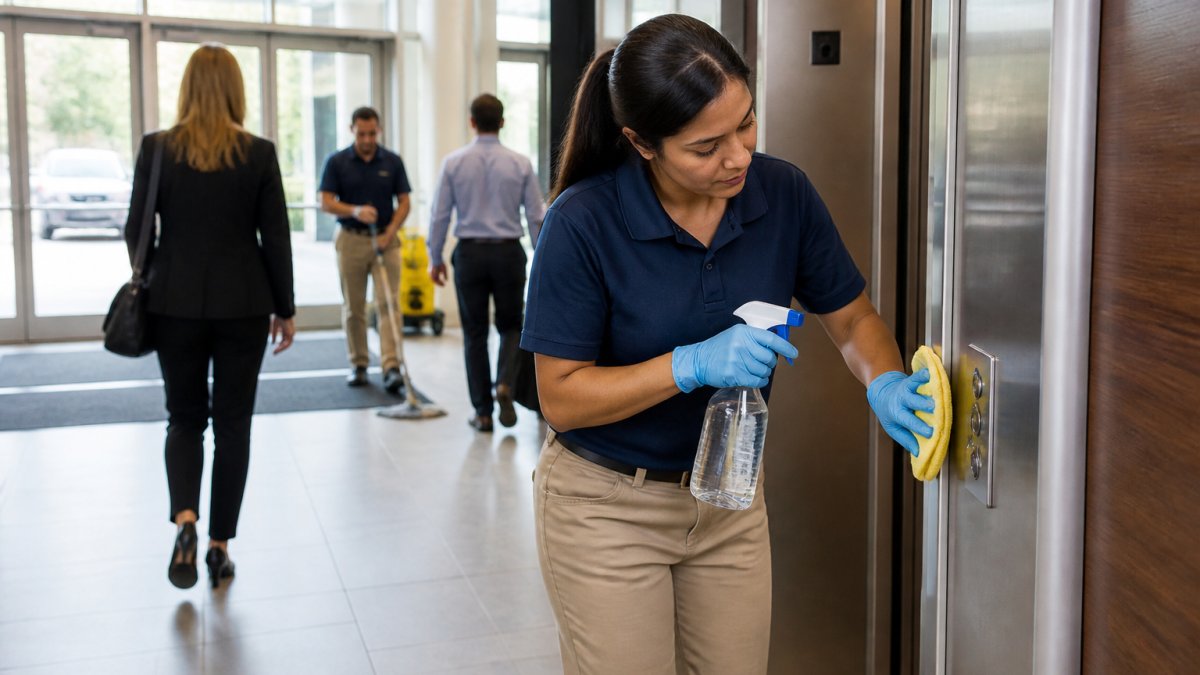
Dwell Time, Disinfection Protocols, and Hazardous Materials
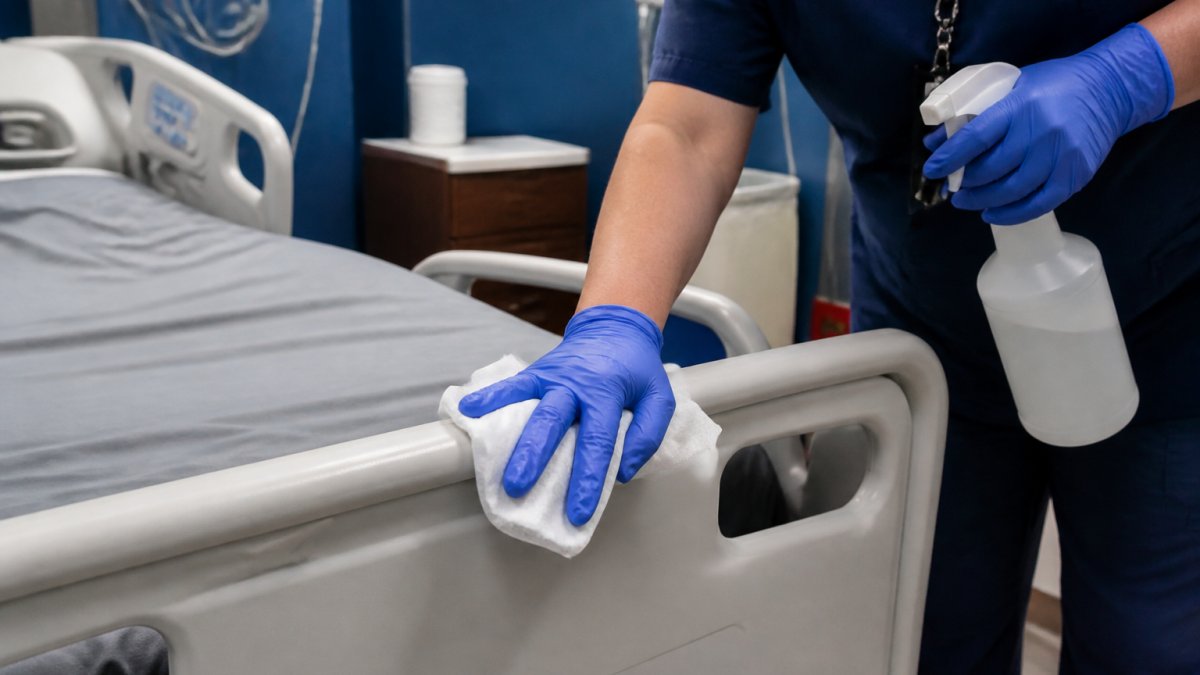
Dwell time is how long a disinfectant must stay wet on a surface to actually kill pathogens. Wipe it dry too soon and you've cleaned nothing.
This is where most in-house teams fall short. They spray and immediately wipe. The product never gets its full contact time.
- Read the label for the required dwell time
- Apply enough product to keep the surface wet for that full period
- Train staff to watch the clock, not their instincts
For hazardous materials, follow the EPA guidance on registered disinfectants and store chemicals per the safety data sheet. Never mix products.
Scale Commercial Cleaning Staffing Solutions Before the Rush
Commercial cleaning staffing solutions should be locked in weeks before peak season, not days. Labor shortages hit hardest when every facility in the region is hiring at once.
The mistake is waiting until you're already short-staffed. By then, good people are gone.
Plan your headcount around your busiest projected week, not your average one. Add a buffer for callouts, which spike during peak.
Cross-Training and Preventing Staff Burnout
Cross-training keeps your operation running when someone calls out. A worker who can cover restrooms, lobbies, and event turnover is worth three who can only do one job.
But cross-training only works if you protect your people. Burnout is the quiet killer of peak-season cleaning.
- Rotate staff through high-intensity and low-intensity zones
- Build real breaks into the schedule
- Track overtime and flag anyone consistently over
At Cleaning Concept Facilities Solutions Services, our OSHA-trained, background-checked teams are managed with this exact balance in mind, which is how we reduce the turnover that plagues the industry.
Use Real-Time Occupancy Tracking to Cut Operational Disruption
Real-time occupancy tracking tells you where people actually are, so you clean around them instead of through them. This is the single biggest gap in most facility cleaning plans, and it is the difference between a static schedule and a responsive one.
Traditional schedules clean a space whether it's empty or full. That creates operational disruption: wet floors in a crowded lobby, noisy equipment during a meeting, staff tripping over guests. Occupancy data flips the trigger from the clock to the room.
How Occupancy Signals Actually Trigger Cleaning Tasks
There are three common data sources, and most facilities end up blending at least two:
- Passive infrared and mmWave sensors: Mounted in restrooms, conference rooms, and break areas. They report a binary occupied/vacant state and a rough count. Best for restroom dispatch and meeting-room turnover.
- Badge and access-control data: Door readers and turnstiles log entries and exits. Useful for lobbies, secure floors, and after-hours zones where sensors are impractical.
- Wi-Fi and BLE density: Access points estimate device counts per zone. Noisy but useful for large open areas like cafeterias and event halls.
A workable setup pipes these signals into your CMMS or work-order platform and applies simple rules. For example: a restroom sensor that logs more than a set number of entries since its last service generates a touchpoint task.
You do not need a full building-automation retrofit to start. Many teams begin with sensors in restrooms and one or two high-traffic rooms, prove the labor savings, then expand.
Thresholds, Alerts, and the Disruption Trade-Off
The value comes from thresholds, not raw data. A sensor that just reports "occupied" all day is noise.
Set thresholds around your actual service standard.
The trade-off is real. Sensor-triggered cleaning can create uneven workloads if thresholds are set too tight, and staff may feel monitored if the rollout is handled poorly.
- Route staff away from crowded areas using live density readouts
- Clean restrooms between rushes, triggered by usage counts
- Schedule deep cleaning and floor care for confirmed downtime windows
The result is less disruption, better use of every labor hour, and a schedule that adapts to peak in real time instead of guessing at it.
Integrate Preventive Maintenance and Equipment Uptime
Preventive maintenance keeps your cleaning equipment running when you can't afford downtime. A broken floor scrubber during peak season isn't an inconvenience. It's a crisis.
Treat your machines like your staff: schedule their checkups.
- Inspect scrubbers, vacuums, and carts weekly
- Replace worn pads and filters before they fail
- Keep backup equipment for critical tasks
Equipment maintenance and cleaning schedules should live in the same plan. When one slips, the other follows.
Keep Sustainability and Air Quality in Check During Peak Season
Sustainability during peak periods is possible without sacrificing disinfection. The two goals only conflict when you treat them as separate.
Air quality and ventilation matter more when occupancy rises. More people means more airborne particles, and peak season concentrates them.
- Run ventilation at higher rates during busy hours
- Use EPA-registered products that meet your sustainability goals
- Choose microfiber over disposables where it makes sense
A facility that smells clean and breathes clean protects its image as much as its surfaces.
Plan Post-Peak Recovery and Measure Cleaning Performance
Post-peak recovery is the phase almost everyone skips. After the rush ends, teams collapse, equipment sits unrepaired, and deferred deep cleaning piles up. Competitors focus almost entirely on cleaning during peak. Treating recovery as a planned lifecycle stage, not an afterthought, is where facilities either reset cleanly or carry the damage into the next cycle.
The Post-Peak Recovery Window
Build recovery into the plan from the start, with a defined window rather than an open-ended "we'll get to it." A common pattern is a three-phase reset:
- Days 1-2, Stabilize: Return to baseline daily cleaning, restock all supply rooms, and clear any backlog of routine tasks. No deep cleaning yet; the team needs to catch its breath.
- Days 3-7, Deep clean and service: Extract carpets, strip and recoat hard floors, deep-clean restrooms and food-service areas, and service every piece of equipment. This is the week the deferred work gets done.
- Week 2, Debrief and reset: Review what broke, what held, and what the schedule got wrong. Update the template before the next peak.
Skipping the stabilize phase is the most common mistake. Teams jump straight into deep cleaning while still exhausted, and quality drops.
Equipment, Supplies, and Deferred Work
Peak season defers maintenance on purpose. Recovery is when you pay it back:
- Service all scrubbers, vacuums, burnishers, and carts; replace worn pads, belts, and filters
- Rebuild supply inventory to pre-peak levels, including backup chemicals and PPE
- Inspect and repair any damage to walls, baseboards, and flooring from heavy traffic
If you keep an equipment log during peak, this phase takes hours instead of days.
Protecting Staff Through the Recovery Phase
Recovery is also a labor-management problem. Overtime spikes during peak, and the same people are expected to carry the reset. Rotate recovery assignments, schedule the deep-clean week with realistic headcount, and give staff time off before the next cycle starts. Post-peak burnout is what drives turnover into the following season.
Metrics That Actually Show Improvement
Measure performance with a small set of metrics you can compare before, during, and after peak:
- Turnaround time: How long from task trigger to completion, especially for restroom and event turnover
- Compliance audits passed: Dwell-time and protocol checks, tracked as a pass rate
- Occupant complaints: Volume and category, so you can see whether disruption actually dropped
Track the same metrics across all three phases. The gap between your peak numbers and your baseline numbers tells you exactly where the plan needs to change before next season.
Conclusion: Managing Facility Cleaning During Peak Without Sacrificing Compliance
Peak season exposes every weak point in a facility cleaning plan. The facilities that hold up are the ones with a real schedule, trained staff, and equipment that works.
If your team is stretched thin, Cleaning Concept Facilities Solutions Services can help.
Get a quote from Cleaning Concept Facilities Solutions Services and keep your facility clean, compliant, and ready for whatever peak season brings.
Frequently Asked Questions
How do you maintain facility cleanliness during high-traffic peak hours?
Split the day into waves instead of one deep pass. Assign a dedicated team to restrooms, entrances, and elevator banks every 60 to 90 minutes during peak windows, and push full floor care to off-hours. Zone mapping keeps crews from crossing paths, and a shared task list lets you reassign staff the moment occupancy spikes. During events or shift changes, station one person at the highest-traffic entry to wipe touchpoints continuously rather than waiting for the next scheduled round.
What are the OSHA requirements for cleaning in high-occupancy facilities?
OSHA requires employers to protect cleaning staff from bloodborne pathogens, hazardous chemicals, and slips under the Bloodborne Pathogens standard and Hazard Communication standard. That means written exposure control plans, Safety Data Sheets on site, PPE, and staff training before they handle disinfectants or body fluids. For healthcare and medical offices, EPA-registered hospital-grade disinfectants with correct dwell time are also expected. Ask any provider for their training logs, SDS binder, and site-specific plan before signing.
How can facility managers optimize cleaning schedules for seasonal spikes?
Start with a facility cleaning schedule template that lists zones, tasks, frequency, and the staff member responsible for each line. Before a known spike (flu season, event calendar, school term), add 20 to 30 percent more labor hours to restrooms and entryways and shift deep cleaning to nights or weekends. Track occupancy data week over week so you can move staff before complaints start. Review the template after every peak and adjust frequency based on actual traffic, not last year's guess.
What role does commercial cleaning staffing solutions play during peak periods?
Commercial cleaning staffing solutions cover the gap between your in-house crew and the extra hands a peak season demands. A managed provider supplies OSHA-trained, background-checked workers, handles callouts and turnover, and cross-trains staff so a restroom specialist can cover event turnover if needed. This reduces your hiring burden, keeps service level agreements intact, and gives you one point of contact instead of chasing multiple vendors. Ask for documentation on training, certifications, and dwell-time compliance before committing.